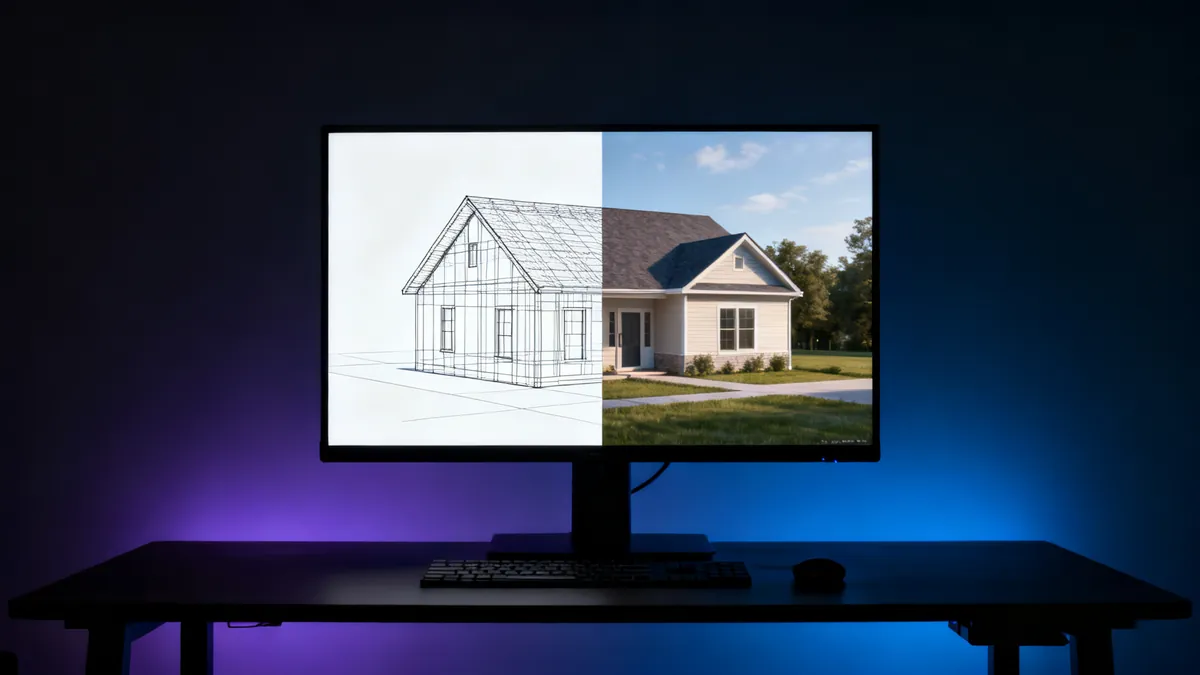
The hardest thing to sell is something that cannot be seen. A visualisation solves exactly that problem: the client views the interior, the piece of furniture or the building before anyone buys the first board.
When a photo is not enough
- The thing does not exist yet: fitted kitchen units, a house on a plot, a trade fair stand.
- The thing exists, but it is at a previous client's place and cannot be photographed again.
- The same product has to be shown in several material or colour variants. With photography, that means as many photos as there are variants; with a model, it means one model and a few renders.
- A cross-section or what is inside has to be shown.
Where it starts
With dimensions. A floor plan drawn on paper is enough, as long as it has numbers: wall lengths, room height, the position of windows and doors. From this, we build a model that matches reality, not one that is merely attractive.
The second set is the materials. A photo of the veneer, the name of the lacquer, the code of the tile. The more specific, the fewer corrections at the end.
How it continues
- Shape and dimensions. At this stage everything is grey and the only point is to get the proportions right. This is the best moment for changes.
- Materials and light. This is where the interior starts to look like an interior.
- Camera views. Usually three: a wide one, one with a detail and one from the eye level of a person standing in the doorway.
- Render and corrections. Material corrections are cheap, geometry corrections are not, which is why the first stage is worth reviewing carefully.
How long it takes
A single interior with dimensions ready and materials chosen usually takes a few working days. Most of the time is taken up not by modelling but by waiting for decisions: which worktop, which tile, whether the window should be as in the drawing.
What a render cannot replace
A visualisation shows the intention, not the actual state. The colour on screen depends on the monitor, and the shade of wood depends on the batch of material. That is why, for sales visualisations, we always suggest one sentence in the offer: that the render is illustrative and the material samples are binding. That sentence saves the conversation at handover later.
What you get at the end
Render files in resolutions for print and for the web, and on request the model itself as well. The model is yours. If you change contractor a year from now, you do not start from scratch.
Visualisations of interiors, buildings and products
See how we do it